Single-Molecular Magnetism (SMMs)
Single-molecule magnets (SMMs) are promising candidates for next-generation information storage devices as they enable magnetic bi-stability at the molecular level, representing the ultimate limit of miniaturization for data storage. However, their practical application is constrained by a key bottleneck-the low blocking temperature (TB), below which stable magnetization can be retained over time.
To overcome this challenge, our approach focuses on two strategies:
(i) establishing structure-property correlations in air-stable transition metal based SMMs by designing rigid coordination and by varying the substituents around it
(ii) enhancing TB and Ueff in Lanthanide-based both air stable and sensitive systems through strong axial crystal fields, near-linear geometries, and control of vibrational relaxation.
Our laboratory is dedicated to the design and synthesis of such complexes, aiming to realize stable, high-performance SMMs suitable for practical information storage applications.
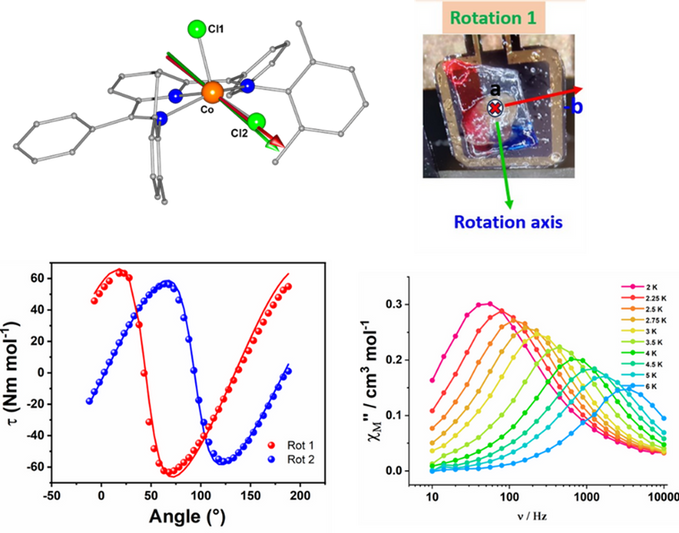
In our recent work, we synthesized a series of five-coordinate cobalt(II) complexes with systematically varied halide coordination, enabling us to investigate their influence on slow magnetic relaxation and establish a clear correlation between halide ligation and relaxation dynamics. The zero-field splitting (ZFS) parameter (D) was successfully quantified using DC magnetic measurements and cantilever torque magnetometry, further supported by EPR and AC magnetic studies, providing detailed insight into the magnetic anisotropy of these systems.
Toroidal Magnetism

Our research focuses on the design, synthesis, and theoretical understanding of advanced molecular magnetic systems, with a particular emphasis on single-molecule toroics (SMTs) and their applications in quantum information science. Building on the fundamental principles of molecular magnetism, we explore how precise control over molecular structure and magnetic anisotropy can lead to emergent quantum phenomena with transformative technological potential.
A central theme of our work is the realization and stabilization of toroidal magnetic states, which arise from vortex-like arrangements of local magnetic moments. Unlike conventional single-molecule magnets, these systems exhibit magnetically silent ground states, making them inherently robust against external magnetic perturbations and highly attractive for quantum technologies. However, achieving such states in discrete molecular systems remains a major challenge due to the stringent requirements on symmetry, magnetic coupling, and anisotropy alignment.
In our recent work, we reported a tridecanuclear Ga₇Dy₆ complex that represents a significant breakthrough in this field. This molecule features a carefully engineered architecture in which two triangular Dy₃ units are arranged to generate a ferrotoroidal (FT) ground state, where the toroidal moments add constructively while the net magnetic moment cancels. The design incorporates diamagnetic Ga³⁺ layers that act as spacers, enabling precise tuning of inter-triangle interactions and stabilization of the toroidal configurationA key achievement of this work is the experimental observation of ultraslow relaxation of toroidal states, with a quantum tunneling relaxation time on the order of ~3.5 × 10⁸ seconds (~11 years), representing one of the longest relaxation times reported for any molecular magnet . This remarkable behavior arises from the suppression of many-body quantum tunneling processes, a direct consequence of the topological nature of the toroidal state and the energy separation between ferrotoroidal and antiferrotoroidal configurationsOur approach combines state-of-the-art experimental techniques—including SQUID magnetometry and micro-SQUID measurements—with advanced ab initio methods such as CASSCF and spin–orbit coupling calculations. These computational insights allow us to map magnetic anisotropy axes, quantify exchange and dipolar interactions, and predict energy landscapes governing relaxation dynamics. The synergy between theory and experiment enables a deep understanding of how molecular structure dictates quantum behavior.
Beyond this specific system, our broader research aims to establish design principles for next-generation molecular quantum materials. By controlling parameters such as anisotropy orientation, magnetic coupling, and structural topology, we seek to create systems with long coherence times, tunable quantum states, and enhanced stability. These efforts are directed toward applications in quantum computing, spintronics, and molecular sensing, where molecular magnets can serve as scalable and chemically tunable quantum units.Overall, our work demonstrates that topological design strategies in coordination chemistry can unlock new regimes of magnetic behavior, paving the way for integrating molecular systems into future quantum technologies.

Single-Molecular Magnetism
Molecular Nanomagnets
★ Designing Single-Molecule-Magnets for Information storage
Ligands will be designed to make large paramagnetic clusters and magnetic properties will be studied extensively. Example


★ Molecular Qubits as a solid state device in Quantum computing Clusters with definite ground state will be targetted and a supramolecular approach will exploited to tether entangled spin Qubits ie. to have controlled interaction between the quantum states. Mainly 4d-transition metal ion based qubits are envisaged as its diffused nature of orbital extremely useful to bring in large super exchange interactions.
★ Magnetic Refrigeration
The Magneto Caloric Effect (MCE), an intrinsic property associated with the large paramagnetic clusters will be exploited to develop magnetic refrigeration devices based on molecular complexes.

Functionalization of molecules on surfaces for electronic device application
This domain of our research activity includes design and synthesis of molecules which can have potential to anchor preferably non-covalently and fine tune electrical property of surfaces like graphene and carbon nano-tubes (CNTs) required for the development of advanced electronic devices.
Our major focus is to reveal new generation of transition or lanthanide metal based stable dopants which is expected to control the electrical transport properties of surfaces such as carrier concentration and mobility. Functional application of these controlled electrical property to develop devices like logic inverter and explosive sensor etc. are the active area of research within our group.
n-doping of Graphene Field-Effect Transistor(GFET) with lanthanide macrocylic Schiff base complex

Integration of n-doped GFET(Functionalized with lanthanide complex) and ambient p-GFET to form a logic interver

Sensors or Electronic Nose Devices

Biological Activity-Probing Amyloid Fibrils
The misfolded proteins (amyloid fibrils) are highly toxic and causes neuro-degenerative disorders in human beings. The normal α- synuclein protein is responsible for the onset of Parkinsion’s disease. Currently there is no early diagnostic test available and finally leads to death. Our research focuses on developing organic/inorganic or hybrid fluorphore to detect, not only the mature fibrils but also the toxic oligomers, which will facilitate to understand the disease progression in its early stage. Besides, we also aim to develop new small-molecule therapeutic strategies against this neurodegenerative disorder."
